
Linear production versus circular production
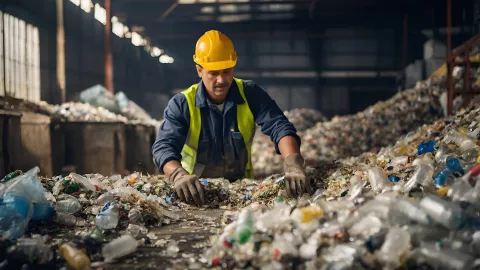
In contrast to a model that disregards environmental impacts, circular production aims to maximize the value of products and materials by using them for as long as possible, extending their useful life, and promoting recycling and reuse. “That’s the fundamental difference from linear production,” confirms Didier Perrin, a professor at IMT Mines Alès and head of the Sustainability and Plastic Recycling research group at the Alès Mining School Materials Center (C2MA). “Right from the design phase, we focus on the end of life of the product—a car or a phone, for example—as well as the disassembly and reuse of materials and components.”
Industrial ecology: a new approach
“The major strategies developed by the circular economy are very different from what we’ve done so far,” explains José-Marie Lopez-Cuesta, professor at IMT Mines Alès, co-coordinator of the Materials program at Institut Mines-Télécom, and academic director of the PRINEC master’s program in Processes and Resources for Circular Economy Engineering (1). To put it simply, in the past, people didn't think about reusing objects or consider recycling or repurposing them." By "in the past," I mean within the traditional framework of linear production—in other words, the "throwaway" model—which generates vast amounts of waste, depletes natural resources, and causes environmental pollution.
This shift toward a circular production model—which focuses on optimizing the use of natural resources, reducing the carbon footprint, and improving sustainability—is widely promoted as a response to environmental challenges but is also heavily regulated (the European Green Deal, the Anti-Waste Law for a Circular Economy (AGEC), the Climate and Resilience Law, etc.) is beginning to emerge across various sectors of activity.
How can this approach be implemented in practice?
The current industrial paradigm is evolving, and the challenge today is to support this change. The shift away from the disposable, linear production model toward the virtuous reuse of circular production is a necessary transformation that requires expert engineers. In response to this demand, IMT Mines Alès and IMT Mines Albi have decided to train these experts in circular economy engineering through materials and processes. With support from the environmental organization Valdelia and in collaboration with expert speakers from the professional world, the schools are offering a new PRINEC Specialized Master’s® program. Building on the concept of the circular economy through materials and processes, this program equips students with the tools to increase resource efficiency and reduce environmental impact in relation to issues surrounding sustainable procurement ; incorporate eco-design guided by the end of a product’s life cycle and the extension of its useful life; and manage waste and new processes in innovative ways.

LEARN MORE ABOUT THE PRINEC ADVANCED MASTER'S PROGRAM
The PRINEC Advanced Master’s® program, Processes and Resources for Circular Economy Engineering, is offered jointly by IMT Mines Albi and IMT Mines Alès, with support from the eco-organization Valdelia.
This six-year degree program explores the concept of the circular economy through materials and processes, addressing the imperatives of sustainable development, environmental challenges, and the shift from a linear industrial model to a circular one.
Objective: to train engineers capable of supporting and even accelerating the widespread adoption of the circular economy.

Experts voices

Produce energy from biomasse and waste? It’s possible!

Mitigating climate change with renewable energy
